
Chapter 1 : What Is a DC Solenoid/Electromagnet
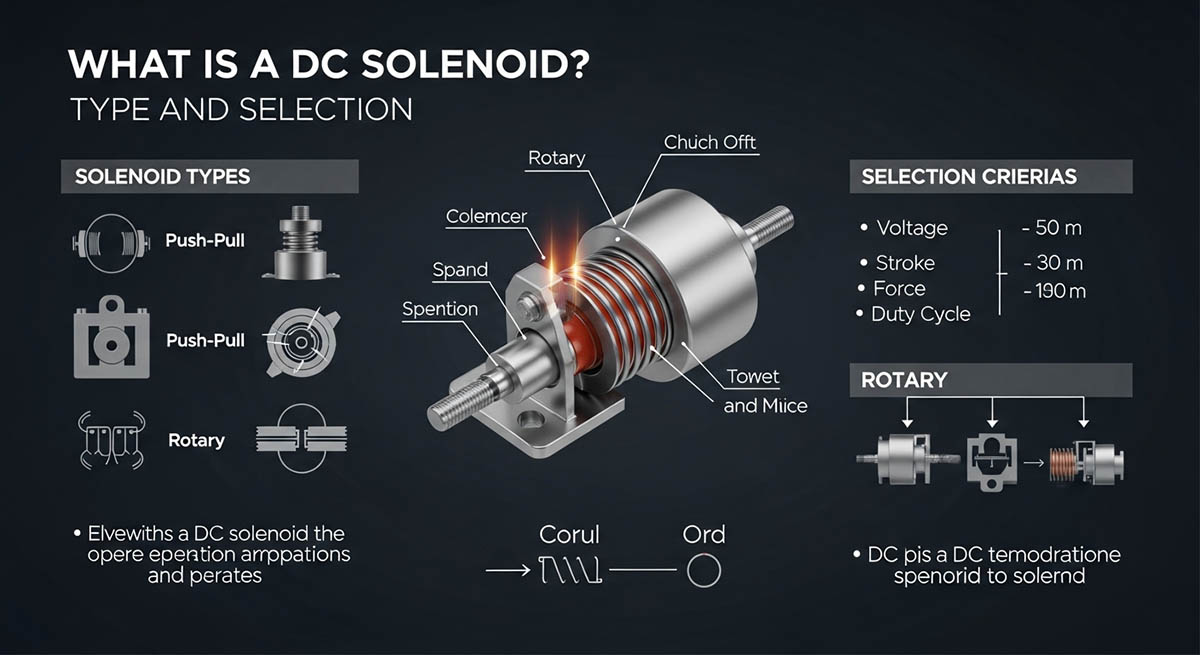
A DC solenoid (also called a DC electromagnet) is a kind of electromechanical device that uses electrical energy to produce linear or rotational motion through a magnetic field.
A DC solenoid consists of:
Iron core
A movable armature/plunger
A copper coil
A bobbin for the coil
A lead wire
The copper coil is wrapped around a bobbin. When a direct current (DC) flows through a coil of a DC solenoid, a magnetic field is created, magnetizing the iron core. This magnetic field produces a mechanical movement that occurs in a linear fashion.
Chapter 2: Working Principle of DC Solenoid
A DC solenoid works on the principle of electromagnetic induction.
When DC Solenoid current passes through a coil of a DC solenoid, a magnetic field is created around a solenoid coil. The iron core gets magnetized. The magnetic field gets stronger with the iron core. A north pole (N) and a south pole (S) are created at opposite ends of a solenoid. When a ferromagnetic object approaches a solenoid, it gets magnetized. The object gets attracted to a solenoid. A solenoid can pull, push, or hold something. For example, in a crane, a DC solenoid uses a strong magnetic field to lift heavy steel materials.
Chapter 3: Key Features of DC Solenoids
3.1 High Magnetic Stability
The DC current remains constant. Hence, a constant magnetic field occurs. This is a desirable feature for precision work.
3.2 Precise Force Control
The magnetic field produced in a DC solenoid is proportional to the current. When a higher current flows through a solenoid coil, a stronger magnetic field occurs. This allows for precise control.
3.3 Fast Response
The magnetic field occurs immediately when a DC solenoid is switched on. When a DC solenoid is switched off, a magnetic field occurs immediately.
Suitable for high speed automation
3.4 Lower Energy Consumption
Compared to AC systems:
No considerable eddy current or hysteresis losses
More efficient for continuous operation
Chapter 4: Types of DC Solenoids
4.1 Types of DC Solenoids by Structure
• Push-Pull Frame type Solenoid
Produces linear motion (push or pull)
Commonly used in relays and contactors
• Tubular / Suction Solenoid
Cylindrical shape
The core is pulled into the coil
Used for automatic doors and locks
• Rotary Solenoid
Produces rotating motion
Used for:
Electric tools
Instrument pointers
4.2 Types of DC Solenoids by Application
Electromagnetic Brake – fast motor stop
Lifting Solenoid – handling magnetic materials
Solenoid Valve – fluid control (open/close)
Pull Solenoid – mechanical actuation
Chapter 5: DC Solenoid vs. AC Electromagnets
Advantages of DC Solenoids
5.1 Stable Suction Force
Constant magnetic force
No fluctuation of magnetic force
5.2 Energy Efficient
Less loss of energy during long hours of operation
5.3 Low Mechanical Shock
Smooth switching operation
Longer lifespan of components
5.4 High Reliability
Current is limited by resistance
Less chance of burning components
5.5 Low Noise
No vibration caused by alternating magnetic fields
Suitable for:
Hospitals
Laboratories
Disadvantages of DC Solenoid
5.6 Requires DC Power Supply
Needs batteries or DC power conversion
5.7 Lower Starting Force
Cannot take advantage of AC peak current
5.8 Larger Coil Size
Needs more turns of wire for a strong magnetic field
5.9 Higher Cost
More complex materials and manufacturing process
Chapter 6: Applications of DC Solenoids
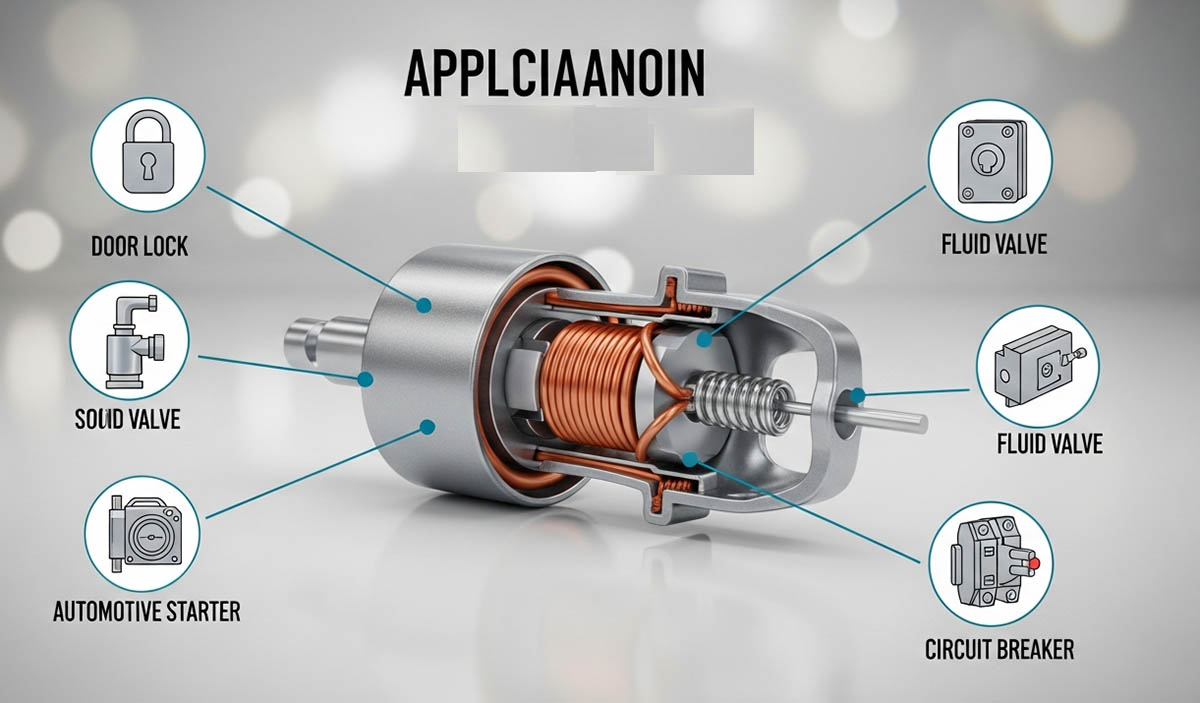
DC solenoids are commonly applied for automation, household appliances, and industrial applications.
6.1 Lifting Equipment
Electromagnetic cranes
Used for handling steel and iron materials
6.2 Rail Transportation
Used in maglev trains for suspension and reduced friction
6.3 Industrial Automation
Valve control
Robotic movement
Production line systems
6.4 Smart Door Locks
Electrically controlled locking/unlocking
Improved safety and convenience
6.5 Medical Devices
Precision movement control
Used in surgical robots and instruments
6.6 Household Appliances
Toasters – tray lifting mechanism
Vacuum cleaners – door or filter control
Microwave ovens – door locking systems
6.7 Automation Systems
Material Handling
Picking and placing small components
Used in electronics manufacturing
Robot Arm Control
Precise motion and positioning
Valve Control
Fluid systems (water, oil, gas)
Fast and accurate switching
6.8 Packaging Machinery
Carton Sealing
Controls pressing mechanism
Film Cutting
Drives cutting tools for packaging materials
6.9 Smart Garage Systems
Garage door control
Parking lock systems
Anti-theft and safety applications
Chapter 7 : How to Choose a DC Solenoid (Electromagnet)
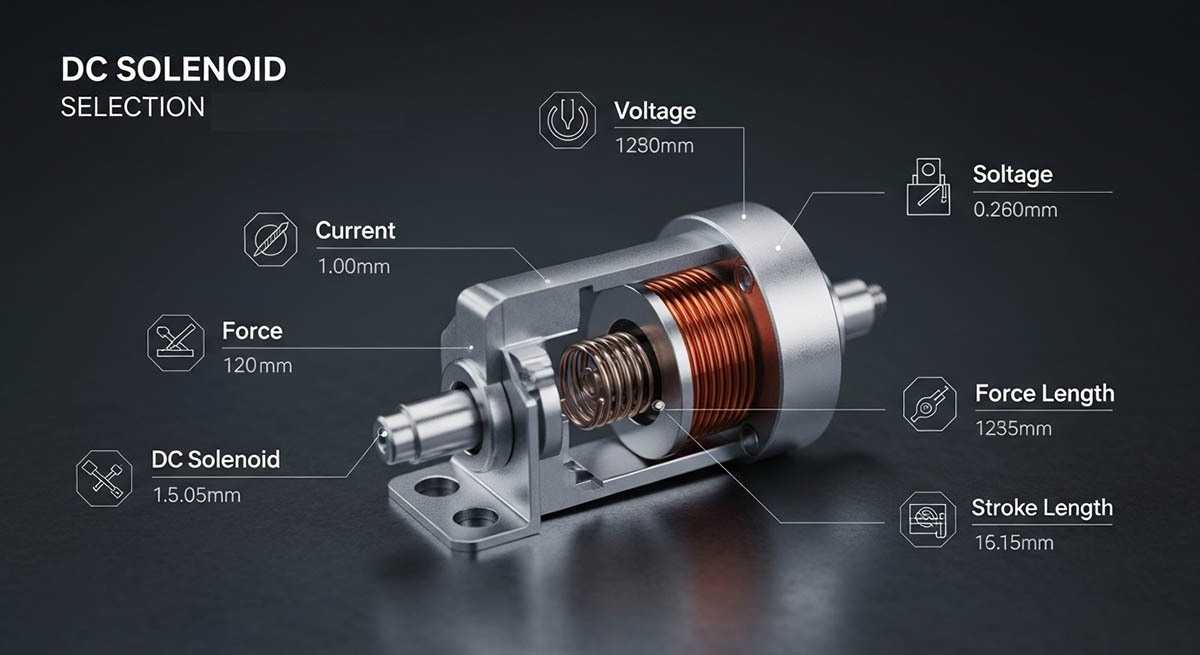
Choosing the correct DC solenoid is a critical step in order to ensure the best possible performance, reliability, and cost-effectiveness. A wrong choice could cause overheating, inadequate force, or even a reduced lifespan.
The following are the important factors you should consider when choosing a DC solenoid:
1. Define the Required Force (Pull/Push Force)
The most important factor is the force requirement.
The weight or the resistance
Friction and safety factor (+20% to 50%)
Note:
The force is greatest at the starting point (closed position).
The force decreases with stroke length.
2. Stroke Length (Travel Distance)
The stroke is the distance the plunger (armature) moves.
Typical ranges: 2mm – 30mm
Longer stroke means less force
Shorter stroke means stronger force
�� Select the minimum stroke required for efficiency.
3. Voltage & Power Supply
Select the solenoid according to the power supply in your system.
Common DC voltage ratings:
5V DC
12V DC
24V DC
Check:
Power supply
Current rating
Power consumption (Power = Volts x Current)
�� DC power supply is required for the solenoid.
4. Duty Cycle (Working Time)
The duty cycle indicates the duration for which the solenoid is activated.
Continuous duty cycle (100%): Always ON
Intermittent duty cycle (e.g., 25%, 50%): ON/OFF
If the solenoid is required to work for a long duration:
Select a low-power solenoid
Avoid overheating
5. Response Time (Speed)
If you require the solenoid to react quickly:
Response time is important
Consider:
Speed of spring return
Important for:
Automation
High-speed machinery
6. Size & Installation Space
Consider the physical requirements:
Length
Width
Height
Mounting type
�� Compact solenoids are essential for:
Smart devices
Medical equipment
7. Type of Motion Required
Select the correct type of solenoid for the application.
Push-Pull (Linear) Solenoid
Most common
Tubular / Suction Solenoid
Rotary Solenoid
�� Select the solenoid according to the mechanism.
8. Environmental Conditions
Consider the environmental requirements.
Temperature range
Humidity/water exposure
Presence of dust/corrosive substances
Optional:
Waterproof
High-temperature insulation
Anti-corrosion coating
9. Lifespan & Reliability
Consider the lifespan.
Lifespan
Number of cycles expected
Material quality:
Copper
Iron
Good heat dissipation
�� Industrial applications require a longer lifespan.
10. Noise Requirements
Environments where quiet operation is a requirement:
Hospitals
Offices
Home appliances
�� DC solenoids are quieter than AC solenoids, but design plays a role as well.
11. Cost vs. Performance Balance
Do not make a decision solely on price considerations:
Less expensive solenoids may have:
Overheat
Shorter lifespan
�� Select on value, not price.
Quick Selection Checklist ✅
Before making a final decision, make sure to check:
✔ Required Force (with a safety margin)
✔ Stroke Length
✔ Voltage & Current
✔ Duty Cycle
✔ Size Constraints
✔ Environment Conditions
✔ Lifetime Requirements
Pro Tip (From Engineering Practice)
When unsure about your requirements, always start with a standard model, then a sample prototype, and finally optimize specifications.
Chapter 8: Summary
A DC solenoid (Electromagnet) is a highly versatile electromechanical device that uses electrical energy to convert to mechanical motion through electromagnetic attraction.
A DC solenoid (Electromagnet) offers many benefits such as:
Reliable performance
Precise control
Fast response time
Quiet operation
The DC solenoid (Electromagnet) plays a crucial role in modern engineering applications such as industrial automation systems and home automation systems.
Chapter 9 : FAQs About DC Solenoids (Electromagnets)
1. What is a DC solenoid?
A DC solenoid is an electromechanical device that uses direct current (DC) to produce linear or rotary motion through electromagnetic attraction.
2. How does a DC solenoid work?
A DC solenoid works by using a direct current to produce a magnetic field that acts on a metal core to move a metal rod.
3. What are the major types of DC solenoids?
The major types of DC solenoids available are:
Push-pull (linear) solenoid
Tubular (suction) solenoid
Rotary solenoid
4. What type of voltage is used in DC solenoids?
The major types of DC solenoids available are:
5V DC
12V DC
24V DC
5. How do I select the right DC solenoid?
You should consider the following factors for selecting DC solenoids:
Required force
Stroke length
Voltage and current
Duty cycle
Size constraints
Working environment
6. What is duty cycle?
The duty cycle is the time for which the solenoid is allowed to work.
Continuous duty cycle (100%) – The solenoid is continuously ON.
Intermittent duty cycle (25%, 50%) – The solenoid is ON for a specified period.
7. Why does a DC solenoid get heated?
The major reasons for overheating of DC solenoids are:
Continuous flow of current
High duty cycle
Poor ventilation
To avoid overheating of DC solenoids, you should consider the following factors:
Proper voltage
Proper duty cycle
Heat dissipation
8. Can DC solenoids work continuously?
Yes, DC solenoids can work continuously if they are selected for continuous duty cycle.
9. What affects the force of a DC solenoid?
The factors that affect the force of DC solenoids are:
Coil current
Number of coil turns
Core material
Stroke distance
The force is inversely proportional to the distance.
10. What is the lifespan of a DC solenoid?
The lifespan of DC solenoids is approximately within the range of 100,000 to millions of cycles.
The lifespan of DC solenoids is based on the following factors:
Working conditions
Load
Material quality
11. Are DC solenoids better than AC solenoids?
It depends on the application:
DC Solenoids:
Stable force
Low noise
Energy efficiency
AC Solenoids:
Higher starting force
Simplified power supply connection (AC mains)
12. What are common applications for DC solenoids?
They find applications in:
Automation
Solenoid valves
Smart locks
Medical equipment
Home appliances
13. Is it possible to have a waterproof DC solenoid?
Yes, some have:
Sealed housing
IP-rated for maximum protection (IP65 or IP67)
They can withstand harsh weather conditions.
14. Why is my solenoid not working?
It may be due to:
Lack of power
Incorrect voltage
Damaged coil (burnt out)
Mechanical obstruction
15. How can I optimize my solenoid’s performance?
You can:
Supply stable DC current
Reduce stroke length
Improve cooling
Choose a suitable type for your application