
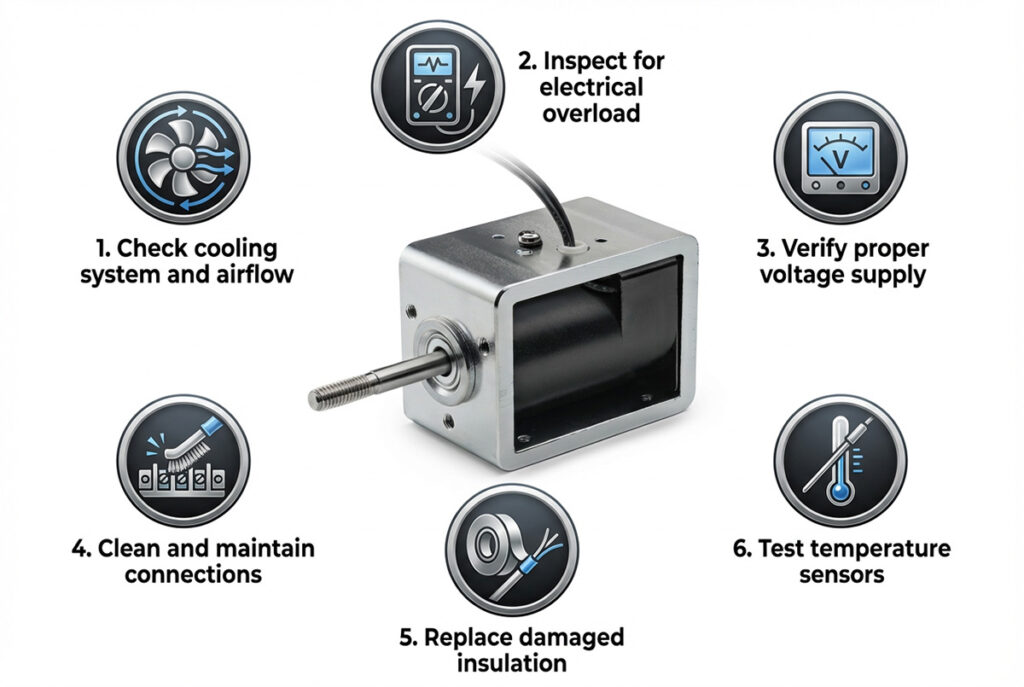
Solenoids are essential parts of production lines and electrical machinery. A malfunction in solenoid operation can lead to breakdowns or incorrect functioning of the entire systems. One of the major invisible hazards that affect solenoids is solenoids’ overheating, which may significantly shorten their service life and impact accuracy. In this article, we discuss what leads to the excessive solenoids’ overheating , the consequences, how to prevent solenoids’ overheating at the designing stage, technical ways of solving the issue, and practical application cases. The target audience includes buyers and engineers.
Chapter 1: Major Reasons for solenoids’ overheating
There are two types of energy losses that result in Solenoids’ overheating, plus some other reasons for overheating in solenoids:
Copper Loss: Occurs due to the electrical resistance of the conductor and current flowing in the coil winding and releasing heat in the form of Joule heat. Copper losses increase with a higher value of current and higher resistance of coil winding.
Iron Loss: Occurs due to changing magnetic fields, leading to the formation of eddy currents and hysteresis losses in core. Iron losses increase with a higher level of core material permeability and higher frequencies of magnetic field.
Some other factors that cause overheating include winding density, poor ventilation, and high ambient temperatures. Additionally, the aging of coil insulation may lead to overheating since aged insulation is prone to accumulate heat, making it difficult to dissipate. Consequently, there is increased local current leakage which leads to even higher temperatures in a self-amplification process of “heat generation – aging – increasing heat generation”.
Chapter 2: Consequences of solenoids’ overheating
There are multiple risks associated with overheating that negatively affect solenoid performance and safety:
Reduced Service Life: Increased overheating accelerates the aging process of insulation and leads to insulation breakdown or even short circuits. Aging of the core deteriorates magnetic properties and reduces suction force of solenoids, decreasing the life span of equipment.
Inaccuracy in Performance: Increased temperatures make coil resistive with unstable current values resulting in decreased magnetic field intensity and speed of reaction. Such effects harm precision of the process, being unfavorable to automated production lines and medical apparatuses.
Risk Factors: solenoids’ overheating warps solenoid housing, burns adjacent equipment, or leads to fire outbreaks in closed, high-temperature environments. It increases energy consumption, leading to growing costs.
Chapter 3: Actions to Prevent solenoids’ overheating at the Design Stage
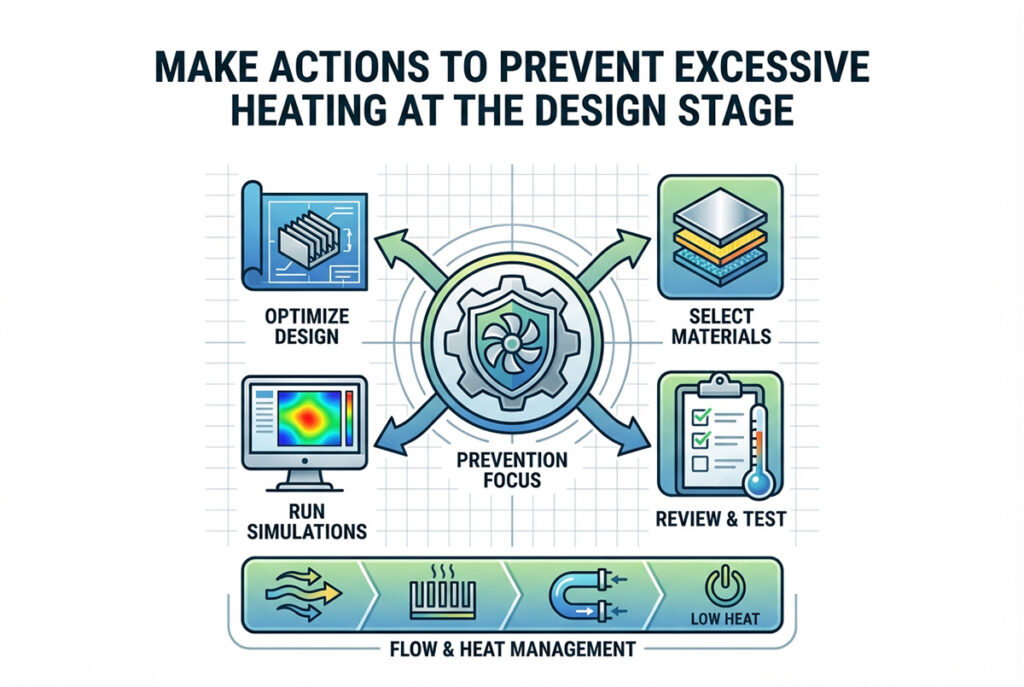
The principle of efficient temperature management of solenoids consists in reducing energy losses and improving heat dissipation at the design stage. Here are four key aspects to consider:
More Efficient Coil Design: Use conductors with lower electrical resistance, such as copper. In order to reduce losses to a minimum level, limit the number of turns and diameter of the conductor wire without affecting winding density and ventilation.
Apply such materials as silicon steel sheets or copper-iron alloys to reduce iron losses. Limit thermal capacity of the core and enhance its thermal conductivity to promote heat dissipation.
Optimized Working Scenarios: To avoid overheating during prolonged full-load operation, select appropriate duty cycles (intermittent or continuous). Provide sufficient heat dissipation capacity if solenoid operates in high-temperature environments.
Optimized Wiring Techniques: Use silver terminals and screw connections firmly to reduce electrical resistance.
Chapter 4: Useful solenoids’ overheating Approaches: Technical Heat Dissipation Techniques
Select one or a combination of several techniques depending on the purposes of using them:
4.1 Improved Structural Design: Passive Heat Dissipation
This technique does not require additional energy, therefore, it is recommended for low-to-medium powered solenoids.
To improve thermal dissipation capacity of core and coil housing, integrate heat sinks (finned plates) in them. Finned longitudinal or annular surfaces of coil cylinders and core-type housing can increase heat dissipation capacity by 30%.
Enhanced Arrangement of Coil Windings: Apply winding to be layered, stepped, or segmented with 1–2 mm air gaps between them.
For example, small DC solenoids designed for toys and relays employ layered winding scheme with air gaps and annular finning of the device housing. Such design allows maintaining coil temperatures below 60°C.
4.2 Highly Efficient Heat Dissipation Materials: Improved Thermal Conductivity
Thermal Conductive Insulating Materials: Use silicone sheets or conductive painting filling inter-layers between coils and core. Using a copper-iron alloy as the core reduces heat dissipation rate twice compared to iron core.
For instance, apply nano heat dissipation coatings on outer surfaces of cores and coil housing. These coatings are highly effective in transferring heat, cooling radiation, and preventing corrosion.
Application Example: Application of nano heat dissipation coatings on cores and coil housing of outdoor high-voltage solenoids (such as power switches) can reduce surface temperatures by 15-20% while preserving insulation integrity in outdoor conditions.
4.3 Forced Heat Dissipation Techniques: Active Heat Dissipation for High-Power Solenoids
Air Cooled Heat Dissipation: Add additional blowers or fans increasing air flow over the surface of the solenoid. Ensure that there is sufficient airflow, uniform channels of air distribution, and filters. It is an inexpensive maintenance-free technique.
Liquid Cooled Heat Dissipation: Applies for solenoids of significant power consumption and heat generation. Cooling liquid (specialized oils and anti-freezing coolants) moves in cooling pipes passing the device in the heat exchange unit. It is an expensive solution but highly effective.
For example, industrial high-power solenoids used to lift steel (of tens of kW power) operate using the water cooled circulation system. They maintain temperatures of no more than 80°C providing safety of lifting process.
Chapter 5: Smart Temperature Control System: A Versatile Approach to the Problem
Temperature Control Sensors: To monitor real-time temperature, incorporate PT100 or thermistors on heating spots (coil, core).
Self-Controlled Temperature Regulation Systems: Self-adjusting operating mode and cooling process. Upon temperature exceeding the critical level, reduce current levels and operating time, as well as activate the forced cooling. Rebooting process occurs when temperature goes back to safe levels. Additionally, provide a possibility to regulate the speed of fan rotation or flow rates of cooling agent depending on the level of temperature and current loads.
Additional Point: Make special passages inside the solenoid to allow heat escape using a combination of convection and forced cooling. This approach is particularly effective for closed solenoids.
Example Application: Engine compartments of cars contain a special type of transmission shift solenoids. These devices have a unique U-shape vent passage allowing the mechanism to avoid sticking in case of high temperature due to proper ventilation.
Chapter 6: solenoids’ overheating Conclusion
In order to control solenoid heat dissipation effectively, it is necessary to perform the following actions simultaneously: minimizing heat losses, improved thermal conductivity, active heat dissipation, and temperature regulation.
Low-Powered Solenoids: Perform passive dissipation (better materials and structural solutions).
High-Powered Solenoids and Precise Machinery: Combining passive heat dissipation with forced cooling (for best efficiency).
Electric Vehicle (EV) Charging Posts represent an example of a case when constant high-load operation is required. Solution includes thermally conductive insulating materials, air cooling system, and self-control of temperatures. Silicone sheets dissipate heat with blowing fans taking it off; thermistors with control module regulate temperatures maintaining them within allowable limits to ensure fast EVs charging.
In order to maximize efficiency of temperature control of solenoids, it is essential to select the most appropriate heat dissipation technique.
Chapter 7: FAQs of Solenoids’ Overheating
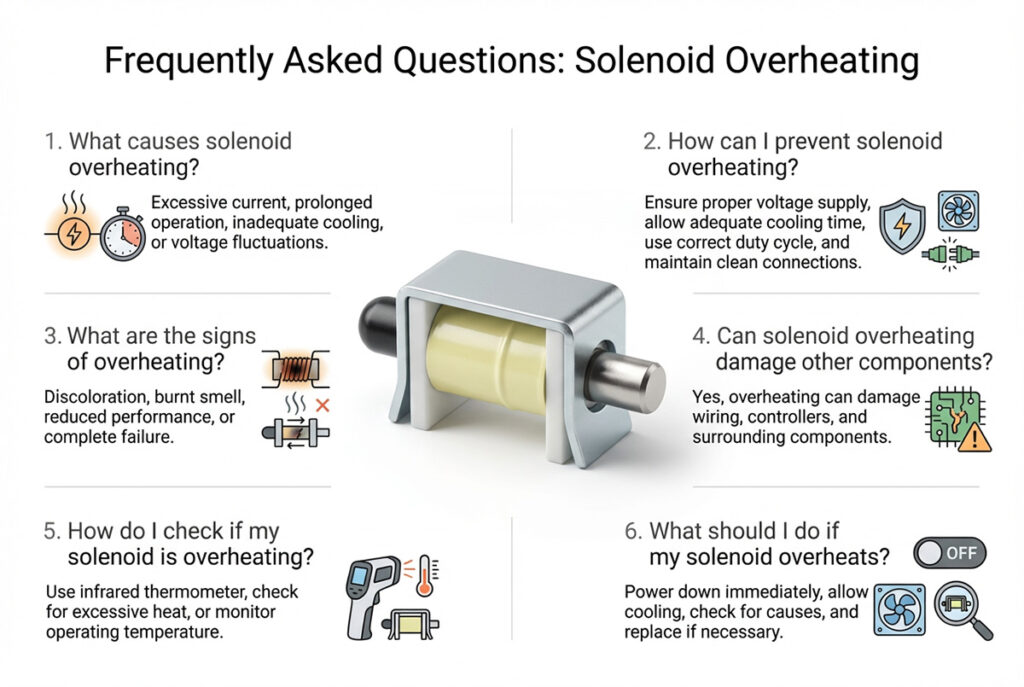
Q1: Why does my solenoid get overheated although it works properly?
A1: All solenoids produce certain level of heat as the natural process caused by copper and iron losses. However, in case of excessive heat, it may indicate high current, lack of proper ventilation, aging of insulation, or unsuitable duty cycle.
Q2: Can my solenoid operate continuously without overheating?
A2: Whether it is possible to keep solenoid operating continuously depends on its operating regime. Proper cooling using the passive or active heat dissipation techniques is needed (heat sinks, fans, liquid cooling). Follow the manufacturers’ instructions always.
Q3: Which cooling system should I select between air and liquid?
A3: Air cooling should be chosen for most applications because it is cost-effective and easy-to-maintain solution. Liquid cooling becomes preferable in case of high-powered devices requiring precise control of temperature.
Q4: What is the most cost-effective solution for reducing temperatures in solenoids?
A4: At first, focus on passive heat dissipation techniques. Consider enhancing heat sinks’ surface area, creating air ventilation paths inside coil windings, and using heat-conductive materials.
Q5: Can I install a complex temperature regulation system for already existing solenoids?
A5: Yes, it is possible. You can integrate temperature sensors and control module into the device allowing regulating its operating modes and turning-on fans of cooling system.
•