
Chapter 1: What is a solenoid?
A solenoid is an electromagnetic device used for converting electrical current into precise linear motion. When current passes through the solenoid, it creates a magnetic field, which, in turn, pushes a plunger. A solenoid is an important device in automation, valve, and lock systems.
Chapter 2: Key Parts of a Solenoid
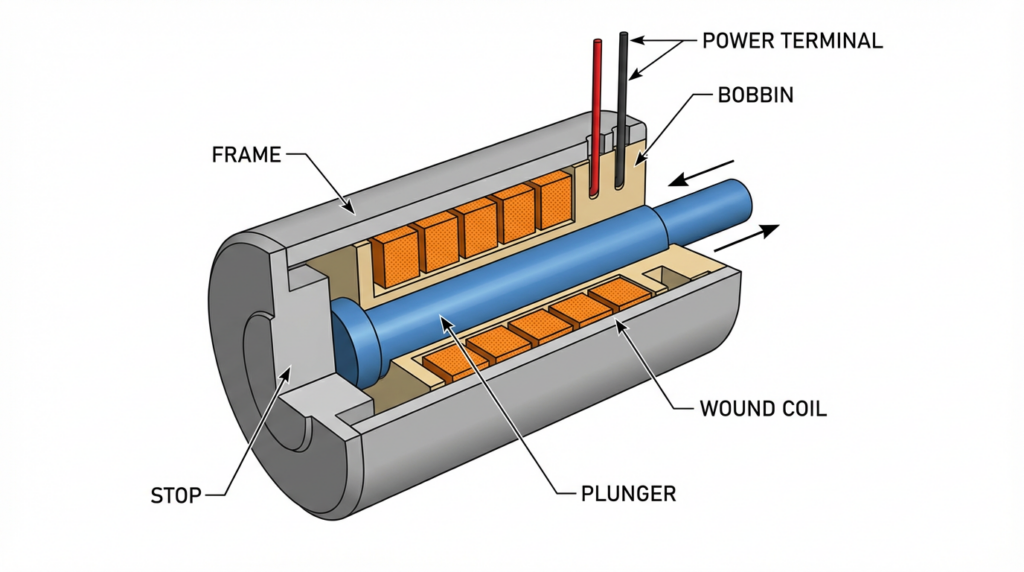
Solenoid Coil: A cylindrical bobbin with copper wires wound around it, which, when turned on, creates an electromagnetic field.
Plunger: A metal rod that moves in a straight line inside the cylindrical object when the solenoid is turned on.
Bobbin: A cylindrical object made of plastic or any other material that does not conduct electricity and holds the coil.
Stop:The final position where the solenoid stops, which prevents the plunger from moving further.
Frame/Housing: This holds all parts of the solenoid together. It is made of iron, which increases the strength of the solenoid.
Chapter 3 : How a Simple Solenoid Works
When DC or AC current passes through the solenoid, an electromagnetic field is generated, which attracts the plunger and moves it into the center of the cylindrical object until it reaches the stop. The solenoid stroke characteristics depend on the motion of the plunger. When current passes out of the solenoid, the electromagnetic field disappears, and the plunger goes back with the help of a spring.
Chapter 4 : The Features of a Solenoid
1. Polarity (Mostly) Not Important
The DC solenoids used in automation and other devices do not care about the flow of current, which means they work equally well with both positive and negative current flow. (Note: Latching solenoids are an exception.)
2. The Duty Cycle’s Importance
Solenoids make things hot. The duty cycle tells you how long the solenoid can be “on” and how long it needs to be “off” to cool down so it doesn’t burn out.
Continuous (100%): Can stay on forever.
Intermittent (like 25% or 50%): Powered for short, recurrent periods of time.
Pulse (like 10% or less): A very short burst of energy.
3. Getting to Know the Force Curve
The force changes during the stroke. The maximum hold force is when the plunger is seated. The force goes down a lot when the space between the plunger and the stop gets wider. Always look at the force curve in the data sheet.
4. Many uses
Solenoids can push, pull, and hold objects by changing its parts. The addition of a spring enables a return feature. More complicated solenoids make it possible to latch, adjust speed, and go in both directions.
Chapter 5 :The Science of Electromagnets
The basic principle behind a solenoid is an electromagnet. It is a temporary magnet whose magnetic field is entirely under control through electricity.
5.1 How It Works
Current Creates Field: A wire coil will produce a magnetic field in its center when current is flowing through it.
5.2 Core Amplification: The magnetic field is greatly amplified when a ferromagnetic core is placed in this magnetic field because the core is a magnet itself.
5.3 Field Control: The magnetic field is directly proportional to the current (I) and the number of turns in the coil (N). It is turned off instantly when the current is turned off.
Chapter 6 : Important Design Note
The direction of the coil’s winding is very important if you are using more than one coil/core. When you use two wires with opposite directions of winding, they produce magnetic fields that complement each other. When they are wound in the same direction, they cancel each other out.
Chapter 7 :Solenoid Buying Guide: Important Things to Look For
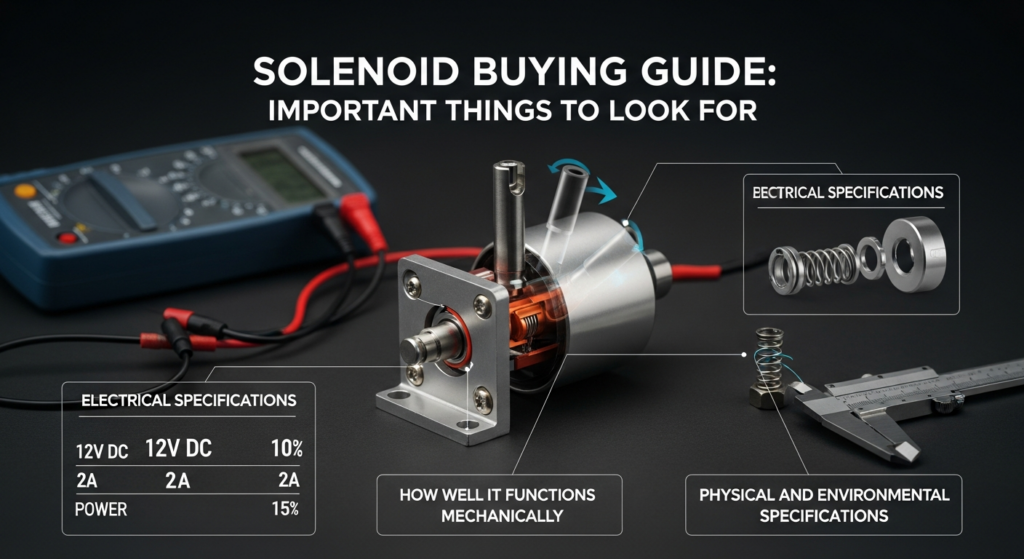
This is a checklist of things you need to consider to get a solenoid that meets your requirements.
1. Electrical Specifications
What kind of voltage and current does your power supply use? Is it AC (such as 120VAC or 240VAC) or DC (such as 12VDC or 24VDC)?
Power Consumption (Wattage): Make sure you have a power supply that can provide sufficient current.
Duty Cycle: Make sure that the solenoid’s rated duty cycle meets your requirements based on how you program your solenoid’s on and off cycles.
2. How well it functions mechanically
Is it a “push” solenoid where the plunger extends out of the solenoid’s body? Or is it a “pull” solenoid where the plunger retracts into the solenoid’s body? Do you need a solenoid that does both?
Required Force (in Newtons or lbs): How much force do you need? Give us the required force initially and the required holding force.
Stroke Length: How far out does the plunger need to go?
Return Mechanism: Does it need a spring return so that it retracts or extends when power is turned off?
3. Physical and Environmental Specifications
How do you want to mount it? Do you need a bracket, a flange, a threaded body, or a flat pack?
Size and Dimensions: Make sure it will fit into your design.
IP Rating (Ingress Protection): This rating is necessary to ensure that your solenoid will be protected from dust and water.
Temperature Rating: Can it be used in areas where the ambient temperature is high?
Noise Level: Is it okay if it makes a humming noise due to the AC solenoid?
4. Special Features and How Long They Last
Latching/Bistable Option: This is important for devices that run on batteries and need to be on only while they are operating.
Sealed/Unsealed: This is very important for fluid or gas valves.
Expected Lifespan (Cycles): Standard models can last millions of cycles, whereas high cycle models can last hundreds of millions of cycles.
Classification and Common Uses
By the Type of Current:
For AC electromagnets:
Generally for use in large actuators or industrial valves. Less complicated. Can also make a hum.
For DC electromagnets:
Best for cars, battery-powered devices, and precise control. Less noise. Easier to control. Fuel injectors. Electronic locks.
Chapter 8 :Application
Valve Solenoids:
Used for controlling fluid or gas valves for fuel systems, HVAC systems, medical devices, irrigation systems.
For Electromagnets for Lifting and Holding:
Used for cranes, magnetic conveyors, security door locks.
For Brakes Electromagnets:
Used for controlling brakes for motors, machines, elevators.
For General Actuation:
Used for printers, vending machines, circuit breakers, robots.
Chapter 9 : Questions That Are Often Asked (FAQ)
Q: How do I decide between a DC or AC solenoid?
A: If you need fast operation, want to plug it into the wall, or need fast cycling capability, then you need an AC solenoid. If you need quieter operation, it is battery-powered, or you currently use a DC supply or a PLC, then you need a DC solenoid.
Q: What makes the “duty cycle” so important when you buy?
A: Going past the duty cycle will make the coil too hot and will cause it to fail. You will need to buy a “100% duty cycle” or “continuous duty” type if you plan on holding something all the time.
Q: There are two force ratings listed on the datasheet. Which rating is significant?
A: You will have to consider two force ratings. Starting/Initial Force is the force required to pull the solenoid. Hold Force is the force required to hold the plunger. Make sure the initial force is sufficient to get everything started.
Q: Is it possible to use a 12VDC solenoid with a 24VDC power supply?
A: No way. You will treble the power and the coil will break right away. Always use the correct voltage. Use a voltage regulator if you need to.
Q: What is the main difference between a permanent magnet and an electromagnet?
A: The main difference between the two is that electromagnets are temporary and can be turned on and off, while permanent magnets have a magnetic field that will always stay the same, like the magnet on the refrigerator.
Q: Are Solenoids harmful?
A: Yes, they are! High force Solenoids can harm you because they can pinch you. High voltage and high current Solenoids can give you an electrical shock! Remember to turn off the current before you install!
Chapter 10 : Conclusion
When choosing the right Solenoid for you, you have to get a balance between electrical specifications, mechanical specifications, and environmental specifications. The right actuator for you can be found by going through the Buying Selection Checklist and writing down the specifications you need, such as voltage, force, stroke length, duty cycle, and mounting type. Learning the basics of these simple but useful electromagnets will get you on the path to engineering success!